
Build a training system you can explain, defend, and adapt.
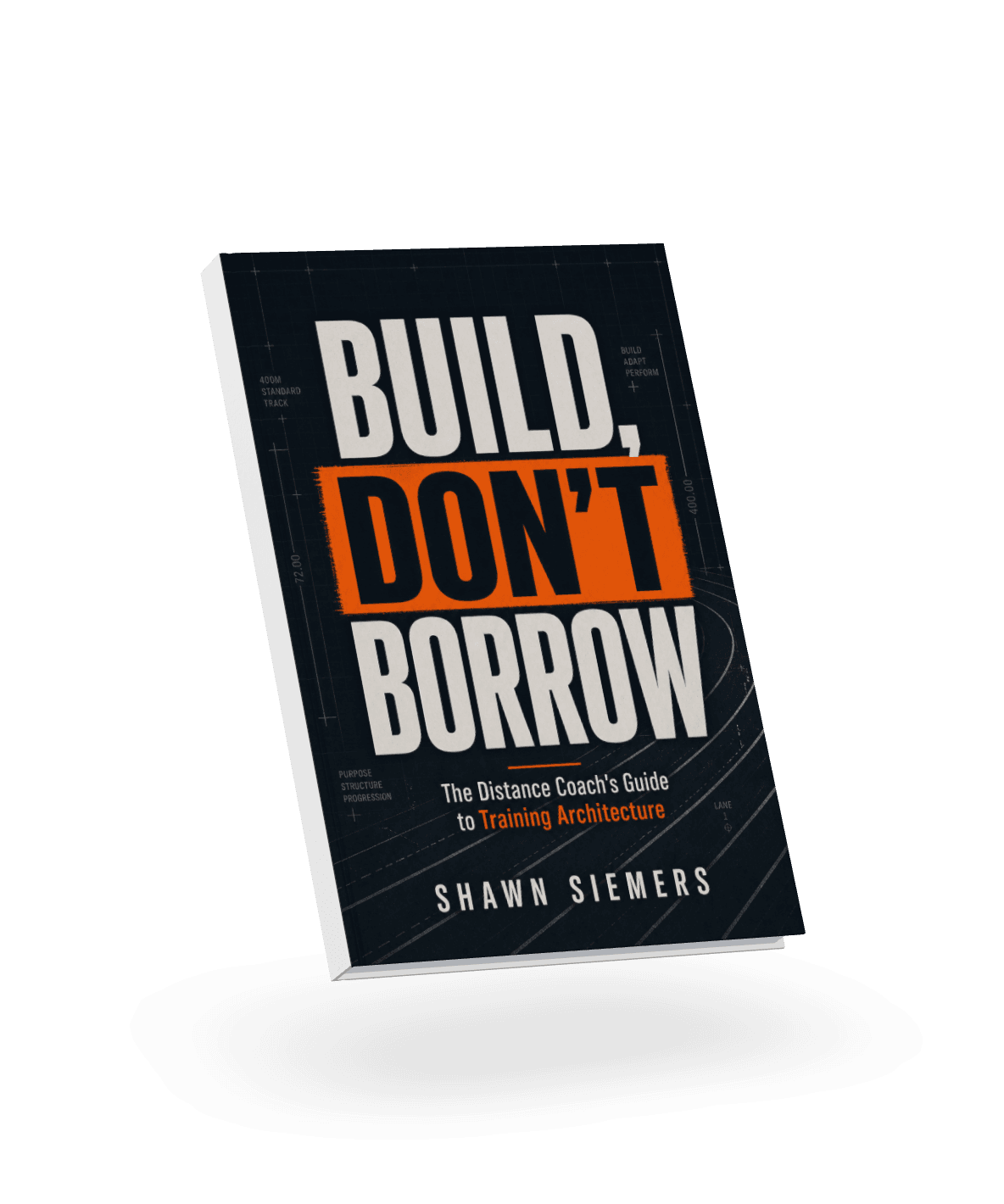
Build, Don't Borrow
The distance coach's guide to turning 23 foundational questions into a coaching system you understand — so you know what to change when the season changes.
By Shawn Siemers
You do not need another workout. You need to know how the pieces fit.
Your notebook is full. You have clinic handouts, training books, saved posts, and workouts from successful programs.
You can build a calendar from those pieces. The hard part comes when an athlete does not respond the way you expected.
A workout from a State championship program feels safer because you know it worked for someone. But you do not know what made it work for that team, why it belonged in that week, or what the coach would have changed if it failed.
You have the pieces.
What you are missing is the structure that connects them.
Borrowed plans work until your season stops looking like theirs.
The athlete gets sick. The heat changes the workout. A race exposes a weakness you did not expect. One training group progresses while another stalls.
Now you have to decide what to keep, what to change, and what can wait. A borrowed plan cannot explain its decisions to you.
So you cut the mileage, add speed, move the long run, or rewrite the taper. The change may work. But if it does, you still may not know why.
If it's yours and it breaks, you learn.
If it's borrowed and it breaks, you're lost.
Build, Don't Borrow helps you make those decisions for yourself.
This book teaches the thinking that produces the plan.
Twenty-three connected questions take you from the athlete you want to develop to the workouts, progressions, and decisions that can get them there.
01
Define what you are building
Start with the runner and program you want to create, then identify what must change to get there.
02
Connect the decisions
Work through the systems, paces, cycles, weekly patterns, progressions, recovery, taper, and athlete pipeline that shape the season.
03
Build a system that is yours
Turn your answers into a structure you understand well enough to explain, defend, and adapt.
The book does not hand you a finished architecture.
It walks you through the questions so your architecture forms from your athletes, your philosophy, and your decisions.
Fixed target. No fixed path.
Finish with more than a complete calendar.
By the final chapter, you will have the major pieces of a training system and a reason for every piece you chose.
- A destination that gives every training decision a purpose
- Clear definitions for the systems you train and the paces you use
- A season structure that connects cycles, weeks, workouts, and recovery
- Progressions with starting points, goal points, and reasons for each step
- A taper and race-execution model that matches what you built all season
- A development pipeline that helps new runners become lasting contributors
When the season changes, you can adjust the part that no longer fits without throwing away everything around it.
I wrote the book I needed when I was coaching from a pile of other people's answers.
From 2010 to 2012, I read everything, attended every clinic I could, and collected workouts from every successful coach who would share them.
I had plenty of information. I could not see how the pieces connected. If a workout worked, I could not always explain why. If it failed, I did not know what had broken.
The 23 questions in this book began as my attempt to close the gap between coaching philosophy and the decisions written on the calendar.
Twenty years coaching cross country and track at Texas 6A schools
Nine straight cross country State qualifications, individual State champions, and a first career designing software systems.
What beta readers recognized
“Architecture is missing from my program, this describes it perfectly. Held together by hope.”
“Best explanation of these concepts I've ever read.”
“This is golden, and something I wish someone would have told me my first years.”
“When it hits the shelves I want my assistant coaches to read it. I want them to challenge me and themselves to build something better.”
See every question before you buy.
Twenty-seven chapters across five connected parts, from defining the destination to building the athlete pipeline.
View the complete table of contents
Introduction
- 1Distance Training Has an Architecture
Part 1: The Impossible Goal
- 2What Are We Building Toward?
Part 2: The Training Architect
- 3The Coach-Architect
Part 3: The Training Model
- 4How Do You Define Each System? What Is Its Relationship to Other Systems?
- 5Why Are Some Paces Described in Physiological Terms and Others With Race Paces? How Do They Relate?
- 6Is There an 800, 1600, 3200, 5K Profile of a Successful Runner?
- 7How Long Is Each Training Cycle?
- 8What Order Should Systems Be Progressed?
- 9How Do You Know Which Combination of Systems to Use? And When?
- 10How Do You Balance Training?
- 11Is There a Methodology?
- 12Are There Training Patterns to Follow?
- 13How Do You Manage Progressions Within a Cycle? From Cycle to Cycle?
- 14How Much Recovery for Each System?
- 15How Long Should Each Work Unit Be?
- 16How Do You Choose a Starting Point? A Goal Point?
- 17Is There a Menu of Workouts for Each System? And a Planned Progression?
- 18How Many Iterations? What Is the Goal of Each Iteration?
- 19Do You Plan by Pace or by System?
- 20How Long for Each Pace? What Pace Do You Emphasize in Which Cycle?
- 21What Does a Sample 1-Week or 2-Week Pattern Look Like?
- 22How Do You Coach Tactics for Each Type of Race?
- 23What Do You Do for Strength Training?
- 24How Do You Taper?
Part 4: The Athlete Development Pipeline
- 25How Do You Start New Runners?
Part 5: The Feedback System
- 26The Architecture Must Be Built Before You Can Measure It
- 27If It's Yours and It Breaks, You Learn. If It's Borrowed and It Breaks, You're Lost.
Read the opening chapter free.
I'll email you the Introduction and the complete first chapter. You will see the problem the book solves, where Training Architecture begins, and whether the rest of the book is for you.
Get the preview by email. Unsubscribe any time.
Stop building seasons from pieces you cannot explain.
Answer the 23 questions. Connect your philosophy to the calendar. Build a training system that belongs to you.
Your athletes graduate. What you learned stays with you.
Buy Build, Don't Borrow on Amazon